Monday, November 8, 2010

The dSLR versus Bridge Debate – Are you a serious photographer?

There is a debate raging in the minds of a few bridge camera fans regarding whether one needs a bridge camera or a dSLR to perform serious photography. By bridge camera, I mean advanced bridge cameras that are about the same size as the entry level dSLRs and have similar controls … sometimes even more controls on the body. These things weigh about the same as small dSLRs and tend to have a fairly long range on the zoom …

So why do I use the qualification “in the minds of a few bridge camera fans” instead of just presuming that the debate rages everywhere?

Well, that’s because the serious (aka advanced) bridge camera is pretty much dead nowadays. The Fuji S100fs is the last really good one, and it has been gone for a year or so by now. The Fuji HS10 has decent controls and a comically long lens -- 720mm :-) -- but a tiny sensor and mediocre image quality at anything but web sizes … and even then. The Fuji S200EXR is the S100fs body with the smaller F200EXR sensor without a lens redesign, so it does not even go down to 28mm … it stops at 31mm. That’s just embarrassing in a modern camera. And that one is dying out anyway. Adobe never even bothered to support its RAW format in Camera RAW.

Panasonic bridge cameras tend to have tiny sensors and shoot very nicely at base ISO only, but they are not versatile at all where light is concerned. They fit in that convenience category for vacation cameras, as do the compact long zooms that I favor. Thus, the bridge market is effectively over.

Now, this does not mean that one cannot do a decent job with these cameras with sufficient planning, and especially at web sizes, where their sensor compromises are not fatal. The S200EXR does have the largest sensor in the genre, and so can make some fine images in good light. But even the most rudimentary modern dSLR (e.g. the inexpensive Pentax Kx) will pretty much stomp it into the dust in the vast majority of shooting situations, and in all light that is less than perfect.

The bottom line is that there is no debate. None. The dSLR is where people go now to do serious photography. The bridge is where people go to have fun. To shoot vacation images and to putter around with wicked long lenses to get a feel for what birding might be like with expensive equipment. But those into serious birding know that there is no substitute for the expensive gear.

So it is with great amusement that I continue to see statements like the following:

I have been slammed for saying this as it apparently is the statement of a lesser than photographer..but I take my S200EXR with me more often than my D90. Its a pretty good rig -not a SLR but it is a good effort by Fuji and versitile..[sic]

Some people still feel that they have to justify taking their bridge camera along when they pop off a few vacation images (this statement was attached to a series of vacation images allegedly shot in 15 minutes) … so I ask – why even think about that issue? Why even care enough to mention it? No one else does. Seriously. The absolute last thing that would have crossed my mind when looking at these images is “I wonder if he also owns a dSLR and I wonder if he has an all in one for it and I wonder why he did not bring that instead?” It’s ludicrous to think anyone else would even notice.

If you think you are a “lesser than” photographer because of the equipment you carry, then you are. And it is not actually because of the equipment, but because you are still thinking of the equipment as a limiting factor. Being ashamed of the equipment enough to preemptively defend it whenever you post is also a really bad sign :-)

Sunday, November 7, 2010

A Blast Through the Past

Basement cleaning time … I’m going through and organizing my son’s crap while he lives abroad and taking the opportunity to organize some of my own crap :-)

While I was looking over some junk, I found a few items that brought back fond memories. Like the Nokia 3320 cell phone, which was a candy bar format phone with a monochrome screen. It was GSM, however, and that made it a decent phone I thought at the time. The reason this phone is a fond memory is that it was the first phone that I got for my two sons as well as myself. We all had one and we had fun with them … we bought cases and fancy lighted keypads on eBay and had a real hoot with these things.

Here’s my own cell phone from back then, I was partial to blue keypads that performed interesting dances of the keys while in calls and while ringing. Can’t show it to you lit up because it’s pretty dead … it even has an old after market Lithium in it … luckily, my office has battery recycle bins set up for every kind of battery so it is easy to dispose of correctly.

DSCF4953_nokia_3320[1]

I also found an old 1.4MB floppy drive. These have a plastic shell and a metal protector for the media exposed at the read slot. This one obviously held a BIOS update for an old motherboard … I’m guessing an Athlon. Anyway … these sucker could hold what would be the equivalent of about 7 seconds of 48k samples per second high quality 16 bit data in stereo. Of course, compression helps a lot … a decent 160kbps stream would allow up to 70 seconds of music on one floppy drive. By today’s standards, that’s a bit of a joke. For a few dollars, you can grab a very small 1GB thumb drive that would hold 50,000 seconds! We’ve come a long way, baby :-)

I remember installing Windows 95 from a set of 25 floppies … and now they must use a good half of a data DVD … call it 2GB. That would require something like 1428 floppies … a little much to handle.

Anyway … here it is in all its glory :-)

DSCF4954_1_4M_floppy[1]

And finally … I real treasure. These suckers are pretty rare. I found a box of three 5.25” floppy drives … the soft kind. These specific ones are double-sided, double-density at 96 tracks per inch, and had a capacity of 720KB. Of the three types of 5.25 inch media, these were apparently the least common. I must have shelled out a bit extra for a drive that could actually read at these densities.

And of course these drives hold about 3.5 seconds of full PCM music and about 35 seconds of compressed music. More if you drop the quality, but not much more. WHich is to say that we can be thankful that these big, ungainly drives vanished fairly quickly.

DSCF4955_5_25inch_floppies[1]

Note how the media itself is completely unprotected when removed from the sleeve. Yuck …

DSCF4958_unprotected[1]

A little peek into the past there … interesting junk.

Friday, November 5, 2010

WEB Design by Drunken Orangutan

I find the number of US vendors who are seemingly afraid of shipping to Canada (hint: we’re real good shoppers and USPS Priority Mail is very reasonable and quick) to be rather disturbing … but I find the number of WEB sites that are designed by people with IQs that would easily be beaten by a sober Orangutan to be even more disturbing.

Case in point: I am looking for replacement horns for my CR-V, which now makes a click when I press the horn button … not very useful in an emergency. The replacement is pretty easy from what I can tell, so I just need a pair of horns. After a bit of research, I think I like the Hella Supertones, an extremely loud pair of disk horns that should fit nicely in behind my grill – right where the existing pair is. And it comes with a suitable relay so I can easily feed it more power with separate fused wiring just to be sure it gets enough.

But Hellas are notoriously scarce in the wild. Amazon.com ships them for a reasonable price, but these horns are one of many items that Amazon is “not allowed” to ship to my address in Canada. PITA!

So as I look around, I see some eBay vendors that are not too bad for price and shipping, but I also check out a few vendors who come up with various Google searches, one of which is JSCSpeed.com … they have the Hellas for a very decent price:

image

That’s lower than anywhere else I have seen, so now I am curious how much they charge for shipping. This is quite variable depending on the options offered (UPS in various flavors versus USPS Priority Post being the contenders usually.)

So I dutifully add to cart and then go to my cart to begin the checkout process. But before I checkout, I click the link to “get a shipping quote.” The page I end up on is very promising … allowing selection of country, state / province, and zip / postal code. Wicked!

But when I get there …

image

:-\

Someone was into the Tequila the day he or she came up with that one … and my sincerest apologies to any drunken Orangutans that may have been offended by the comparison to WEB designers who make mistakes like these …

Update: Just picked up a set of these from an eBay seller with a 99.9% positive rating on over 10,000 items … and I got the set for $77usd shipped!, which today is just about $77cad as well.

For those who might be interested in hearinf the Hellas in action … take a listen:

Now those are some irritating horns :-)

Pentax K5 Leads DXOMark … but by how much? Examing the K5 versus the Kx versus the D3100 … the newest kids on the block …

And of course we are now seeing bold statements like “there is a a new king” yada yada yada … another poster uses the words “blow away” with respect to the new Pentax lead over others … but I consider that sort of hyperbole more like “blowing smoke” … lots of heat and light, not much fire.

So let’s take a closer look here to see if Pentax are going to wax the competition in this generation of sensors. First, let’s examine the DXOMark comparison of the Kx and the K5 against Nikon’s entry dSLR, the D3100. The D7000 is not available on DXOMark yet, but I’ll look at that one when it arrives …

image

What you see here (click the image to go to the comparison on DXOMark.com) is that the D3100 and the Kx are essentially identical in noise. The Kx does take the lead, building slowly to a full stop at 12800, but frankly, that’s a rather silly level at which to shoot with APS-C. With certain subjects, of course, it can be used … but the image must be fairly dark overall to hide the rampant noise and smoothing that goes on.

Note also that the level at which an image is considered “excellent” is 30dB on this graph … and all three cameras are only above that at 800iso. The Kx has about 1/6 stop lead here, which is effectively invisible, and the K5 has only 1.5dB, or 1/2 stops lead. While it might be considered useful to have that half stop, it certainly is not blowing the D3100 away. Skill with exposure and processing makes far more difference than that difference in RAW SNR.

To be fair, the K5 is only 1/3 stops below 30dB at 1600iso, while the others are a bit further away … so this 2/3 stops difference might be visible under some circumstances.

And after that, the Pentax cams use some form of smoothing that is significant enough that DXO labs felt it necessary to call it out explicitly on their charts. I don’t really know what that means, but I can guess that fine, low-contrast details might be an issue at extreme ISOs. We’ll see as the review pour in I suppose.

The numbers on that graph do show that the Kx is well ahead of the D3100 at 6400iso, and is actually about equal at 12800iso to the D3100 at 6400iso. So how do we see what that means? Well, that’s pretty easy, since imaging-resource.com provides samples from both of these cameras shot under the same lighting. Once we normalize the D3100 to the Pentax size (it;s a tiny amount, but let’s make the images identical in size), we can see how this works out in real life.

image

Well, that’s nothing to write home about …. is it … in fact the D3100 looks about the same as the Pentax at 6400iso, with a bit more noise perhaps (not much) but with a bit less feeling of “helmet hair”, which is very prevalent with the Kx images. I suppose we can all understand what “smoothing” means when looking at these. The 12800iso image is not close at all to the D4100 at 6400iso ,,, much more smoothing and a lot of mottling present there.

So for low light work, any of these cameras is going to ve very suitable. The K5 is definitely leading by the time we reach 1600iso, but not enough to make a massive difference in practical use. Skill will easily trump a 2/3 stops lead. But regardless, if this “smoothing” does not prove to be a trick that costs too much detail, the K5 looks to be a pretty good low light cam.

But let’s take a look at dynamic range before we get too far ahead of ourselves.

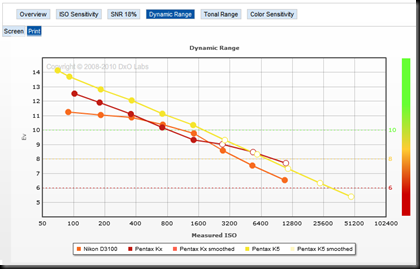
imageNow here, Pentax is looking like a miracle worker. Look at the lead at base ISO. Almost 3 full stops! Wow!. There is not much question that one should seriously consider the Kx for landscape and perhaps for wedding use. That’s a non-trivial lead. And here the term “blow away” is pretty appropriate. So with dynamic range, there is definitely some fire …

Note, however, that when you get indoors and start shooting at 800iso and above, the dynamic range difference between the D3100 and the K5 has narrowed to less than one stop at 800iso and about a half a stop at 1600iso. So wedding shooters won’t see much difference (and these cams are in a very different cost class.) The more appropriate comparison is the Kx to the D3100, where the Nikon leads by .2 and .4 stops at 800iso and 1600iso respectively. Not a big lead, but the point being that the dominance of Pentax is not complete. These are very common ISOs at which one shoots inside.

So … landscapers can celebrate that the K5 is their newest answer for 1600 bucks (current Adorama price for the body.) This is pretty decent pricing for such a capable camera. The Kx is actually quite cheap at just over 500 bucks while the D3100 is a bit more money than that … at least 140 more I think. But I also think a comparison of the rest of the features and the systems might prove interesting … anyway, all three are great cams.

I’ll run something similar when the K5 samples are available on imaging-resource.com and when the D7000 has been tested by DXOmark and also has samples on imaging-resource. As with the above low-light detail test, things are not always as expected when the rubber meets the road …

Caveat: The charts are based on measurements in RAW mode … i.e. pretty much what the *sensor* is capable. The actual images compared represent the jpeg engine output, which is what the *camera* is capable of when you let it do the conversions from RAW. Make of that what you will.

Thursday, November 4, 2010

D7000 versus D700 versus D3100 in Low Light at High ISO – *** updated 4 Jan 2011

The buzz started as soon as the D3100 and D7000 were announced. This generation of APS-C sensors would pull off the miracle of equivalence with the last generation of FX sensors. The D700 would be equaled by a mere DX camera! Of course, that was wishful thinking for those who thought they would get D700 performance on the cheap.

And the results are in … this new generation of sensors is lovely … the results at high ISO are very useful in small to medium prints. A great 8x10 is easily achievable at 3200 ISO in my opinion … and for some subjects, 6400 ISO should be possible too.

But equivalence in detail retention under difficult lighting is not in the cards.

As has become my habit, I will again demonstrate my point with the excellent images from http://imaging-resource.com,  a site that has managed to keep excellent consistency in the ISO series with the mannequin, the only series that really interests me. I consider all of these cameras to be stunning at base ISO, so if you cannot make a great print at base ISO from any of these cameras, then look to your technique and skills. But at high ISO, things get pretty hairy and the camera and sensor make a lot of difference.

All images used here are copyright © 2009-2010 http://imaging-resource.com … click on each image to see the large version.

Unfortunately, the D700 mannequin shots appear only in jpeg, while the other two have NEF files, so the D700 would be at a bit of a disadvantage if I proceeded along those lines. Still, the FX sensor should be able to hold its own even with that disadvantage. And in fact, I pile another disadvantage on it by upsizing the D3100 and the D700 to match the size of the F7000. So all crops are 16mp.

So let’s look at 800px images from the three cameras first at 3200 ISO.

D3100

D3100INBI03200[2] D7000

D7000INBI03200[1] D700

D700INBI03200[2]

My analysis is that the D700 already shows a lead in detail retention. The other two are perfectly usable, and kudos to Nikon for that, but the hair has more texture in the D700 shot and the red flowers actually have detail. This, of course, could come from having better picture controls fro the D700 in ACR. But while the subtlety of FX tones are not lost on this comparison, the differences are fairly small at web sizes and score a near-tie for DX. These cameras are already both winners in my book.

Let’s skip 6400 and jump straight to 12800 for this full image comparisons, as I don’t want to fill the article with images when the crops are coming for all three ISOs.

D3100

D3100INBI12800[1]

D7000

D7000INBI12800[1]

D700

D700INBI012800[1]

Here, the differences are starting to really pile up. The hair detail is dramatically different, as the D700 retains a lot of texture while the others necessarily clump the hair into an almost helmet-like mass when enough noise reduction is applied to control the luminance noise, which is really severe. Note, however, that the luminance noise is still fairly fine-grained and the chroma noise is almost non-existent, so this generation of sensors is definitely better than the last generation at extreme ISOs. This bodes *very* well for the D400 when it arrives …

A second major difference is the appearance in the DX shots of a blur cast in the shadows and on the red flowers. There is a prominent color shift there, which is a classic effect when the pixels start to get really tiny. I see it all the time on small sensors, and obviously DX sensors are not completely immune at extreme ISOs. I am sure extra processing could handle it somewhat, but once this sort of thing sets in, the jig is up …

So … pretty obvious victory for the D700. In fact, looking at the crops, the D700 looks to be between 1 and 2 stops ahead when you factor in detail and noise, which is right where it should be given the laws of physics and all …

And now the crops to make it all so very clear.

d7000_d700_d3100_crops[1] Reminder – Click through to see the big version!

TANSTAAFL … There ain’t no such thing as a free lunch :-)

Update: Wow … this dog continues to hunt :-) … so I thought I’d do a second set of crops at 3200 ISO, showing different parts of the frame. I processed thought ACR only, and only for white balance, noise and detail. I downsized the APS-C cams to match the D700, the opposite of the method last time. No matter which way I go, the advantage rests with the larger images, in this case the two APS-C cams.

Remember to click through to see the really huge version. And remember to click on that to get full size once in your browser.

My analysis of the crops left to right:

  • D700 easily wins on the hair crop. The APS-C cams are good, but the D700 shows a real difference in actual hair detail over the clumping of the others.Skin texture is also better and I prefer how the D700 handled the red channel, the image is warmer.
  • The D3100 breaks down a tad on the stem where it joins the flower. The edges are suffering from artifacts. Still pretty good in the rest of the crop. The D7000 looks just fine, but I still prefer the more open shadows on the D700 shot.
  • The D7000 loses the fine detail on the label, but retains it on the cork. The D3100 loses even the cork’s fine details. The D700 is the clear detail winner.
  • This one is tricky as there are depth of field and focus point differences here that I cannot account for. What I can say is that the D7000 wins in an absolute sense (notwithstanding the unknown reasons behind the sharpness differences) and that the D7000 shows how well it holds detail in shadows (stitching in the collar’s shadow.) So this is at least a tie between the D700 and D7000.

Even after this update, my bottom line is that the APS-C cameras are improving and are certainly viable low light shooters, but that the universe continues to unfold as it should in that the full frame sensor continues to pull much better detail at higher ISOs.

But the really good news is that the next generation of full frame sensors look extremely promising … I think we’ll be seeing D3s-like performance in all the new cams, assuming Nikon will stop at a reasonable pixel count for the D700 replacement (16mp is just right in my opinion.)

Wednesday, November 3, 2010

Macro at High Magnification

What do I mean by high magnification? That would be 1:1 or better. What 1:1 means is that the image is life-sized on the sensor itself. Which is to say that it’s like the subject lay on the sensor and was scanned. Pixel for pixel match.

Most macro lenses these days have the ability to focus really, really close and shoot at 1:1 magnification. The Sigma 105 f/2.8 is the lens I use for macro and I got it cheap on eBay … about $250. Doesn’t get much better than that. Also makes a nice portrait lens.

To increase magnification even further, you can insert a teleconverter in between the lens and the camera. This adds extra glass elements, but at 1.4x, high quality prime lenses often look just fine. But cheap lenses and zooms will have their aberrations magnified along with the subject, so think twice before using the images. Test it out for sure.

And of course you can add a nice achromatic filter (two-element corrected) to allow the whole setup to focus closer. The Canon 500D is available reasonably priced on eBay for example. Note, though, that you should typically avoid the single-element versions that cost 10 bucks, as they add blur and tons of CA to your images. Junk.

Here is the kit I mentioned on a Nikon D70s.

DSCF1872_macro_setup[1] And here are some examples of what that kit can do, either from tripod without the flash, or hand held with the flash (insects mainly.)

First, in a light box from tripod:

DSC_0385_clippers[1]

DSC_0656_clippers_bw[1]

Now, with flash hand held":

DSC_0288_bee_close[1] DSC_0508_dragonfly_face2[1]

A crop of his eyes …

DSC_0508_eyes[1]

DSC_0536_caterpillar[1]

So get out there and take a shot at this stuff … it’s fun …