Saturday, January 12, 2013

Video Blog 3 – Panasonic GX1 Bounce Flash

Bounced flash looks about 100 billion times better than direct flash for most subjects. And that’s not hyperbole. The texture and dimension flattening effect of bright light landing from straight ahead just sucks the life out of pretty much any image.

Example:

P1010635_DMC-GX1_45 mm_ISO 800_1-160 sec at f - 1.8
Panasonic GX1  & Olympus 45mm 1.8  800iso  f/1.8  1/160  direct built-in flash

P1010636_DMC-GX1_45 mm_ISO 800_1-160 sec at f - 1.8
Panasonic GX1  & Olympus 45mm 1.8  800iso  f/1.8  1/160  bounced built-in flash

If you cannot see the difference here, then please give up photography Smile

Anyway … I recorded a video blog to discuss this … enjoy …

Wednesday, January 9, 2013

F800EXR vs F770EXR – Review Part 1 – The Arrival

MSL (Fuji Marketing in Canada) sent me the announcement for the spring cameras from Fuji, a rather delectable group and the subject of a near-future post, and we got to talking over email about the cameras to be reviewed starting around April of this year.

Well, Sacha suggested that he had an F800EXR available for review and would I like to review it while I wait for the new ones? Well, of course I would :-) … and many thanks go to MSL for keeping me on their list after a really bad summer knocked me right out of the game for months.

That was yesterday, and my door bell rang a few minutes ago and what to my wondering eyes did appear? Well, not a drunk bunch of reindeer and a case full of beer, in case you were wondering. But rather FedEx with the usual armor plated shipping container that MSL use these days for moving these cameras around the country.

I immediately put the pair of them (their F800EXR and my new F770EXR) together and you would be forgiven for confusing them with each other as they are twins. The only obvious difference from the front is the GPS stenciled on the F770 and whatever that us stenciled on the F800 :-)


panasonic g5 & olympus 45mm 1.8  1600iso  f/1.8  1/20

Yeah, it’s very dark as you can see by the exposure. And the light sucks, so I had to correct white balance in LR. And yet the image is amazingly clean. That’s why I like the m4/3 cams.

Anyway … to reinforce the twin concept …


panasonic G5 & olympus 45mm 1.8  1600iso  f/1.8  1/15

Now that’s a nice pair …

Good GOD internet people, a little precision please!!!

If I see this kind of rotten spelling one more time, I will scream Smile

This comment from an article on Apple versus Android, just to set the context:

In 2012 Android enjoyed a 72% market share versus Apples 13%. Maybe a more informed approach to the article would be "Does Apple need to slash prices to keep it's small place in the market intact and not loose relevance?"

It is LOSE, not LOOSE. If you pronounce the words correctly, you get the right spelling EVERY TIME.

LOSE means you no longer have something, as in it is now gone. It has a hard Z sound. LOOSE means not tight. It has the soft S sound.

Sheesh Smile

Waaaaa … I crashed my toy helicopter and almost burned my house down …

Tuesday, January 8, 2013

Why spend money on space travel?

One need only look at the incredible number of financial issues facing us (everyone) these days to wonder whether we should even spend a dime on space travel. After all, the infra-structure is crumbling, there are sick and starving people all over the world, and so on.

And there is no shortage of people who write comments on various news articles complaining about this very misappropriation (in their eyes) of public funds. This recently came up once again on The Weather Network of all places … in the comments to an article on NASA’s tentative plan to capture an asteroid and pull it into Moon orbit for ease of study without the dangers of deep space travel.

In answer to yet one more comment on hunger etc, one person linked to a letter from 1970, written by Ernst Stuhlinger, then NASA’s Associate Director for Science in answer to a question from Sister Mary Jucunda, a nun based in Zambia at the time. It is a thoughtful piece and is something that should be required reading for every human being on this planet. There is no better way to get a bit of perspective than by reading someone who already has it and knows how to express it …

The letter is now in an article called “Why Explore Space” published earlier this year on a web site call “Letters of Note”, which is an attempt to gather interesting or important correspondence of all kinds together to make them available as general reading.

It is a very long letter and I certainly do not plan on regurgitating it here … you should definitely read the whole thing here:

http://www.lettersofnote.com/2012/08/why-explore-space.html

But let me leave you with 2 things to ponder even before you read it …

First, a classic image of the Earth as seen from the surface of the Moon. This shows just how vulnerable we are as a species, living as we do on a relatively small ball of dirt with everyone on the planet sharing the same razor-thin atmosphere.

And second, my favorite quote from the letter …

Significant progress in the solutions of technical problems is frequently made not by a direct approach, but by first setting a goal of high challenge which offers a strong motivation for innovative work, which fires the imagination and spurs men to expend their best efforts, and which acts as a catalyst by including chains of other reactions.

Panasonic G5 – Electronic Shutter Test

So the question came up recently on the forums regarding shutter shock and very long lenses on the G5. The question being:

Does the G5’s electronic shutter help when shooting with a long lens at low speeds like 1/25 or 1/50? Or does the mechanical shutter work as well?

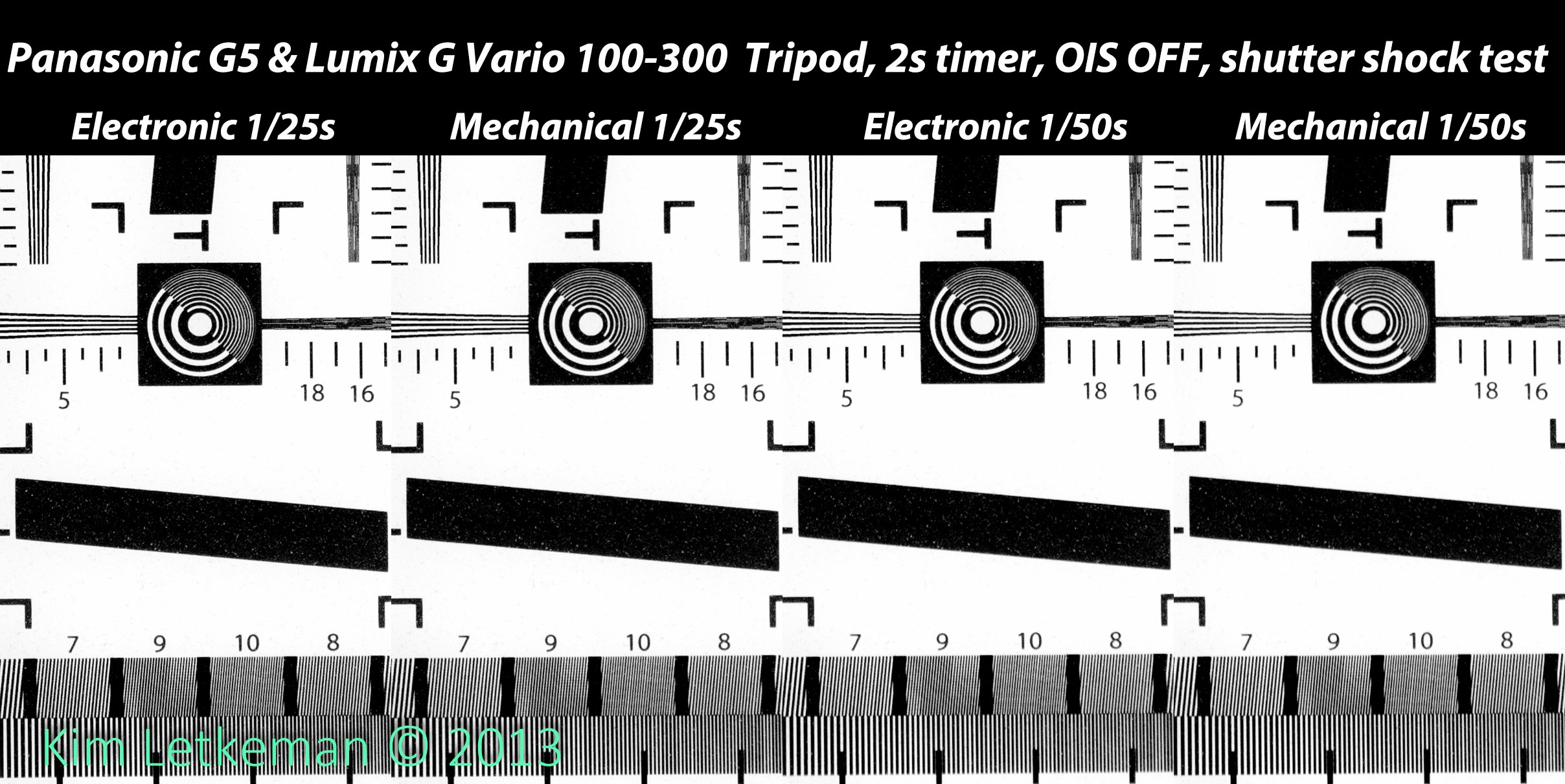
Simple enough, yes? I decided to test it with the 100-300 with OIS switched off at the lens and with the camera on an old Velbon tripod with 2s timer release. Since I have the shutter on a function button, this was trivial to do without moving the camera at all. Note that 300mm is 600mm effective, so this is a lot of magnification and should be sensitive to shutter shock.

I set Shutter Priority (I knew there was a use for that dial position :-) at 1/25s and ISO at 1600 since I was shooting in a dark room. The following juxtaposed 100% crops show that there is a tiny difference between the electronic and the mechanical shutters, but it is close to undetectable.

To see it properly, you will have to click on the image and then click again to see the expanded image in your browser.

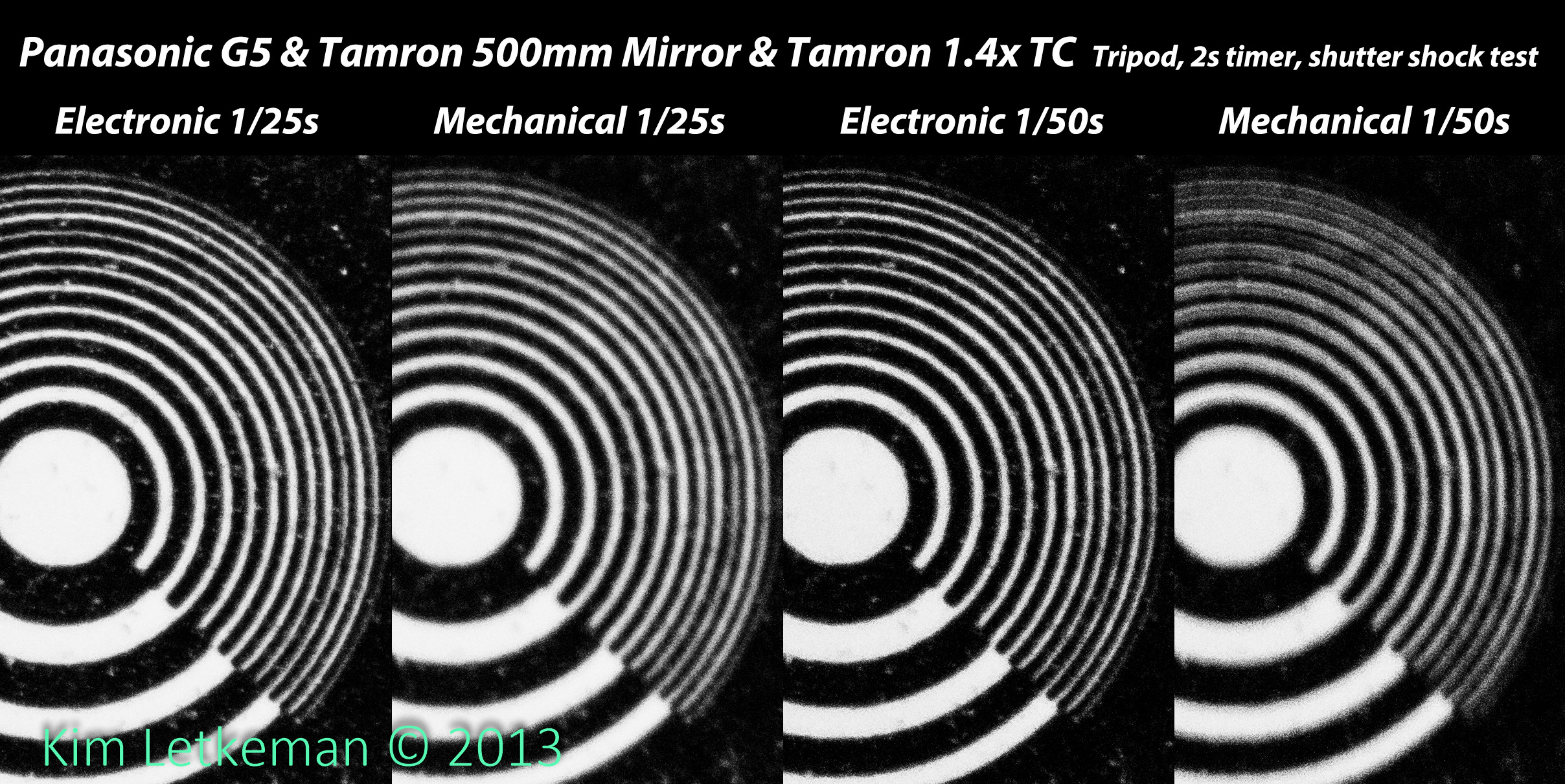
Someone then asked how this applied to the Tamron mirror lens, which of course is 1000mm EFL. But I went one better this time, and used the Tamron 1.4x teleconverter with it for an EFL of 1400mm. Yowsa!

If there was any doubt that it mattered in the first series, that is completely erased in this series. The electronic shutter is unequivocally superior!

So there you have it. If you wanna shoot the moon and the planets with a normal tele on a mirrorless, you will be wanting the G5 or GH3 and setting that e-shutter on.